Complex mobility. One coordinated pathway.
When a serious motor vehicle injury changes the way someone drives, travels, uses a wheelchair or accesses their home, their needs rarely fit neatly into one service.
Williams OT supports Lifetime Support Scheme participants and Service Planners with driver assessment and rehabilitation, vehicle modification, wheelchair and seating, and home modification assessment.
Driver assessment & rehabilitation→
Vehicle modifications→
Wheelchair & seating →
Home modifications→
Williams OT is listed by the Lifetime Support Authority as a Specialised Assessment Provider for Wheelchair Assessments and Home Modification Assessments, and has provided LSA driver assessment and rehabilitation services since the Scheme commenced in 2014.
What is getting in the way of independence?
You don’t need to determine the solution before referring. Start with what has changed for the participant.
Returning to driving
The participant wants to explore returning to driving following their motor vehicle injury.
Driving requires modification
Physical, sensory or cognitive changes may require modified controls, equipment trials or an adapted driving pathway.
Getting in or out of the vehicle is difficult
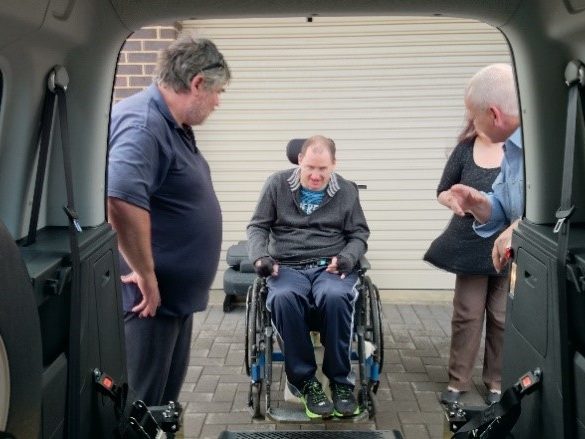
Transfers, wheelchair loading or passenger access are limiting safe and practical transport.
The vehicle may need modification
The participant may require driving controls, transfer assistance, vehicle access or equipment transport solutions.
Wheelchair or seating needs have changed
New or changing physical needs require assessment of mobility, seating or wheelchair equipment.
The home environment is creating barriers
Access, transfers or daily function within the home have changed following injury.
Several of these problems overlap
Driving, wheelchair, vehicle access and home requirements need to be considered together rather than in isolation.
If you are not sure where to start, tell us what has changed and what question you need answered. Our team can help identify the appropriate Williams OT pathway.
Returning to driving can involve much more than a driving assessment.
Following a serious motor vehicle injury, returning to driving may require assessment of physical, cognitive, sensory and functional abilities as well as consideration of the vehicle itself.
Williams OT’s driving pathway can include occupational therapy driver assessment, on-road assessment, driver rehabilitation, modified driving instruction, vehicle modification assessment, equipment trials and training.
Where modifications are required, the aim is to connect the assessment, equipment and rehabilitation pathway rather than treating each stage as a separate problem.
Here is our three-step plan:
STEP 1
We assess
We assess the person’s driving and mobility needs, trial equipment where appropriate, and provide clear recommendations and reporting.
STEP 2
We implement the pathway
Where appropriate and approved, we coordinate rehabilitation, equipment trials and the vehicle modification pathway.
STEP 3
We support the next step
We support the person to work towards safe driving, or identify an alternative mobility pathway where driving is not appropriate.
The car is only one part of the mobility picture
A person’s mobility needs do not reset when they move from the home to the wheelchair and from the wheelchair to the vehicle.
A participant may require a wheelchair that works within the home, enables safe positioning and transfers, fits their transport arrangements and remains compatible with their longer-term driving or passenger needs.
Looking at those environments together can identify conflicts earlier and support more practical long-term solutions.
Home ↔ Wheelchair & Seating ↔ Vehicle Access ↔ Driving
Williams OT can contribute across each of these environments.
More than a driving assessment

Driving & Vehicle Mobility
Driver assessment
Driver rehabilitation
Modified driving instruction
Vehicle modification assessment
Driving equipment trials
Passenger access
Wheelchair transport considerations

Wheelchair & Seating
- Complex wheelchair assessment
- Manual and powered mobility
- Seating and positioning
- Equipment trials
- Transport considerations
- Long-term functional requirements

Home Modifications
- Functional home assessment
- Access and transfers
- Environmental barriers
- Complex modification assessment
- Long-term functional requirements
- Clinical recommendations
Williams OT is listed by the LSA as a Specialised Assessment Provider for Wheelchair and Seating, and Home Modification Assessments. Williams OT has also provided driver assessment and rehabilitation services to LSA participants for more than a decade.
Specialised assessment for complex needs
The Lifetime Support Authority maintains a Specialised Assessment Provider List for providers meeting additional requirements for particular complex assessments.
Williams OT is currently listed for
Complex Home Modification Assessments
Complex Wheelchair and Seating Assessments
and has provided LSA driver assessment and rehabilitation services since the Scheme commenced in 2014
For Service Planners, this provides a clear pathway to a Williams OT team that can also consider how these needs interact with driving and vehicle mobility.
When the vehicle needs to change with the participant
Motor vehicle modifications may support an LSA participant to return to driving or travel safely as a passenger.
Depending on the participant’s needs, modifications may involve alternative driving controls, vehicle access, wheelchair loading, transfer solutions or other equipment.
Williams OT can assess the functional need, trial appropriate options where required and provide recommendations to support the LSA’s decision-making process.
Driving modifications
Hand controls
Steering controls
Pedal modifications
Secondary controls
Transfer and seating solutions
Passenger and access modifications
Wheelchair access
Hoists
Transfer equipment
Wheelchair transport
Vehicle access solutions
Today’s solution also has to make sense tomorrow.
Significant injury can create needs that change over time.
A wheelchair choice can affect vehicle access. Vehicle access can affect transfer methods. Transfer requirements can affect the home environment.
Assessments should therefore consider not only the immediate problem but also the participant’s functional goals, likely future needs and the environments in which equipment will be used.
Why refer to Williams OT?
Driving at our core
Driving assessment and rehabilitation has been central to Williams OT since the organisation was established in 2011.
Connected services
Driving, vehicle modification, wheelchair and home modification needs can be considered together where appropriate.
LSA specialised assessment listing
Williams OT is listed for Wheelchair and Home Modification Assessments.
Clear communication
We aim to provide clear clinical reasoning, recommendations and next steps to support Service Planner decision-making.
What information helps us get started?
- participant details
- Service Planner contact details
- reason for referral
- relevant injury and medical information
- current functional concerns
- participant goals
- specific question to be addressed
- relevant reports
- equipment or modification history
- funding approval or scope where available
Don’t have everything yet? Contact us and we can advise what is needed to get started.